
Our feet carry us throughout our lives, taking thousands of steps each day. Yet we often only think about them when pain, discomfort or a cosmetic problem appears that we cannot manage at home. Instead of seeking professional help straight away, many of us put off an appointment for weeks or months. Why? Shame, embarrassment and fear of being judged.
If the thought has ever crossed your mind: “My feet look too bad, I’m embarrassed to show them to anyone”, this text is just for you.
Why do we feel ashamed before visiting a podology practitioner?
Feet stay hidden in socks and shoes for much of the year. We regard them as a very private part of the body, and problems such as cracked heels, thickened nails, corns or warts are sometimes mistakenly seen as signs of poor hygiene.
This is a widespread and harmful misconception. These problems rarely result from poor hygiene. They are most often caused by:
- disturbed gait biomechanics and anatomical conditions,
- poorly fitting footwear, such as shoes with narrow toe boxes,
- sport and excessive strain,
- systemic diseases (e.g. diabetes or thyroid problems),
- infections that can be easily transmitted at the swimming pool, gym or hotel.
A foot problem is a health issue, just like a dental cavity or a rash on your hand.
What does a visit look like from a podology practitioner’s perspective?
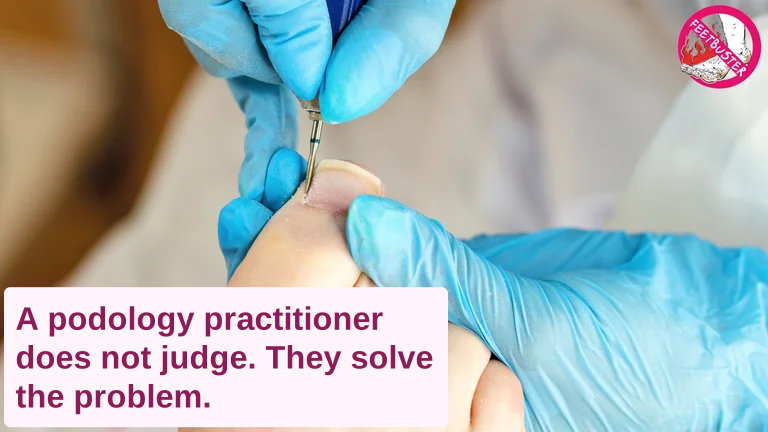
A podology practitioner sees a problem on your foot as something to address, never a reason to judge you.
- Approaching the problem: a podology practitioner examines the skin, nails and pressure points to find the cause of discomfort. The appearance of someone’s feet is not a reason to judge them.
- Full discretion and empathy: A podology practice is a safe space. The priority is always to relieve pain, restore comfort and create an atmosphere in which the patient feels cared for and respected.
- Safety and hygiene: Treatments are performed in sterile conditions, using professional, disposable or autoclaved tools.
What NOT to do before your first visit?
Many patients, under the influence of anxiety, try to “prepare” their feet for the visit. This is a very common error that can make correct diagnosis difficult!
- Do not file the skin aggressively: Do not use foot files, pumice stones or callus shavers the day before your appointment. The practitioner needs to see the skin in its natural condition and identify where hardened skin forms.
- Do not cut away lesions yourself: Trying to cut out a corn or an ingrown toenail at home often causes inflammation and makes precise professional treatment more difficult.
- Do not apply nail polish: If you have any doubts about the nail plate, leave it in its natural state so that the podology practitioner can assess its condition and structure.
Simple, everyday hygiene is enough – washing your feet before leaving the house is completely sufficient.
Overcome fear – take the first step to comfort
Postponing the visit means that minor, easily remedied ailments may turn into painful, chronic inflammation. Remember that taking the first step and signing up for a consultation is an act of taking care of your health and the quality of your everyday life.
An appointment may help reduce discomfort and concerns about showing your feet to a specialist.