
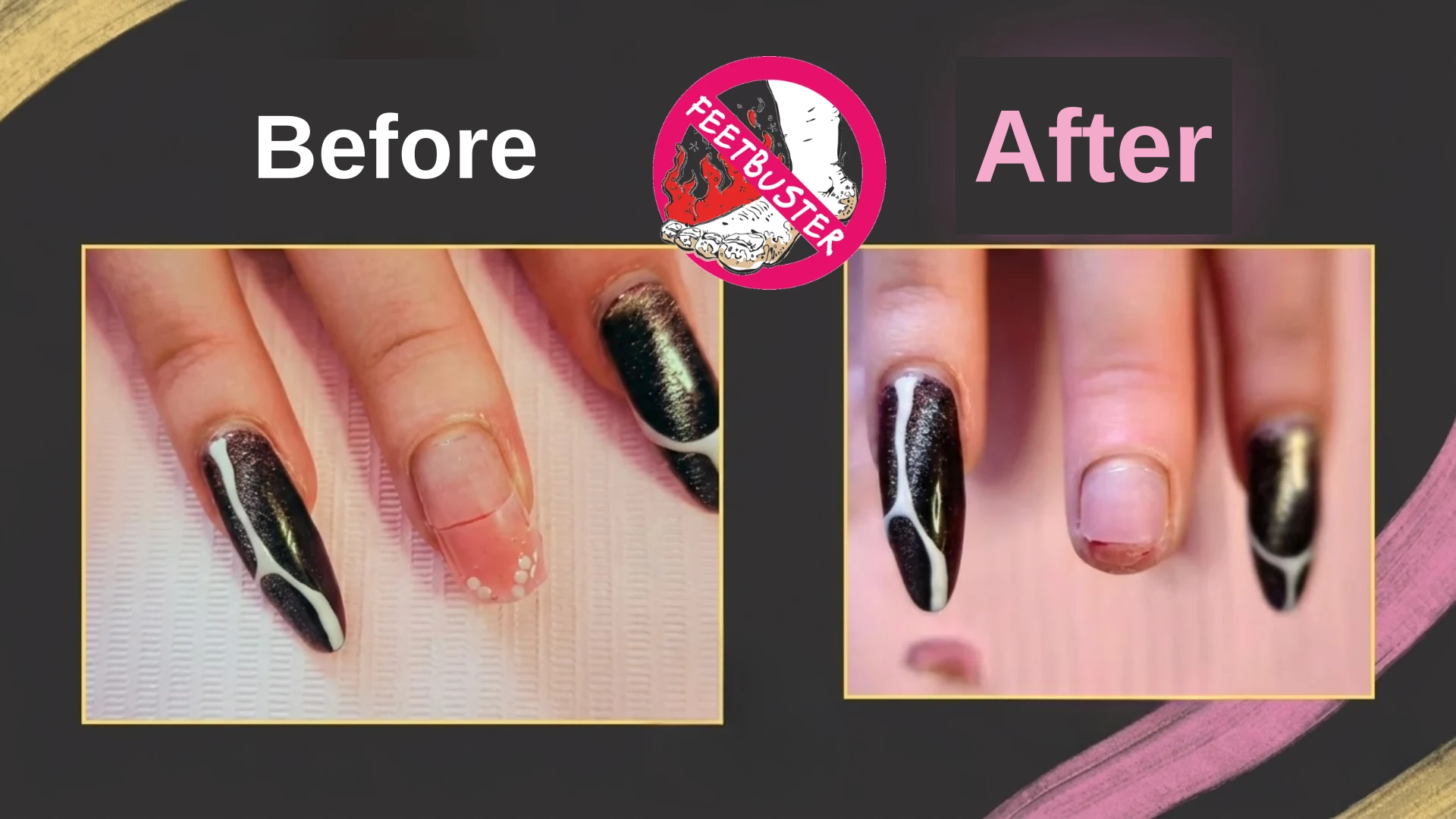
Many of us dream of long, slender nails that make our hands look elegant and provide a canvas for intricate designs. But length is about more than appearance: it also involves health and engineering. As nail technicians, we need to understand how mechanical forces act on the nail plate so our clients can enjoy beautiful hands without pain or complications. Here, we explore the fascinating, sometimes complex relationship between nail length and the health of the nail at its base.
The mechanics of a long nail: the lever effect
Imagine a simple physical experiment. When you open a can of paint, you use a screwdriver. The longer the screwdriver, the easier it is to pry the lid off. Why? Because there is leverage here. In the world of physics, a long fingernail works exactly the same way.
The rule is simple: Long nail = greater leverage.
A long nail acts as a lever: with the same impact force, a longer free edge increases the bending moment. The effects of an injury depend on the direction and force of the impact. The nail plate, nail bed or matrix can be damaged.
The effects of excessive stress on the nail matrix
The matrix is the nail’s “factory”. New cells form there, harden and become the nail plate. This delicate area is essential for healthy growth. Excessive stress on the matrix from overly long nails can cause several problems, some of which may be permanent as well as painful:
- Micro-injuries: Repeated small forces can cause microscopic damage to the matrix tissue. Initially invisible, this damage can eventually disrupt keratinisation and produce a weaker nail plate.
- Onycholysis: This is the separation of the nail plate from the nail bed. Overload can “tear off” the nail at the base or sides, creating empty spaces that are an ideal environment for the growth of bacteria and fungi.
- Pain and deformities: Chronic overload may cause pain in the nail fold area. In extreme cases, permanent deformation of the shape of the plate or even the matrix itself may occur, resulting in the growth of a distorted nail.
- Breakage under stress: When the force is too great, the nail can simply break. This most often happens in the “stress zone”, where the free edge separates from the nail bed, and can be extremely painful.
What increases the risk of excessive stress?
Understanding the mechanics is one part of the picture. We also need to know which factors can make our “lever” dangerous:
- Excessive length: the nail catches on objects more easily and acts as a longer lever when struck.
- Incorrect enhancement structure: an unsuitable length, thickness or shape increases the risk of the product cracking.
- Thin or soft enhancements: A weak, flexible material cannot absorb and cushion impacts. Instead of protecting the nail, it allows forces to pass directly to the nail bed and matrix.
- Mechanical impacts: Of course, violent impacts are the most dangerous. However, even everyday, small taps (e.g. on the keyboard) have a cumulative effect.
How can you prevent excessive stress and protect the nail plate?
Fortunately, as professional nail technicians, we have the tools and knowledge to prevent this from happening. Here are the key principles that we should apply in our daily work and convey to our clients:
- Match the length to the client’s lifestyle: This is fundamental. If a client has an active lifestyle, works with her hands or plays sport, do not suggest extremely long nails. A safe, functional length is essential for nail health.
- Pay attention to the enhancement’s structure: adapt it to the nail’s length and the product used. Even a correctly applied enhancement cannot protect against every injury.
- Choose an appropriate enhancement product: follow its intended use and the manufacturer’s instructions rather than assuming that a harder material always protects the nail better.
- Arrange regular infills: Over time, enhancements wear down, small cracks can form in the product and the stress zone can shift. Regular infills, every 3–4 weeks, are needed to maintain the correct structure and strength.
To sum up, remember this golden rule: The longer the nail, the greater the strain at the root.